
FLOAT VERSUS TIME RISK ALLOWANCE
By: Sean Vermaak
19 May 2026
Float
There are many articles written about float and time risk and this one reflects my perspective based on years of planning and scheduling experience. I hope it offers useful guidance to those seeking answers.
Float ownership is often disputed between owners/clients and contractors, raising the recurring question of who the schedule float belongs to, who may use it, and to what extent?
The starting point is to understand the different types of float to identify which float is contested/disputed. The debate almost always centres on total float, its ownership, who may use it, and to what extent.
Free Float
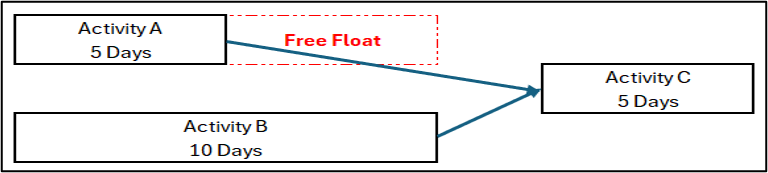
Free float is the amount of time an activity can be delayed before impacting the early start of the succeeding activity.
Fig. 1 below shows Activity B is the controlling activity to Activity C and any delay to Activity B will have a direct impact on Activity C start and finish. Therefore, the critical / longest path routes through Activity B and Activity C. Activity A can start 5 days later or take 5 days longer to perform before it impacts Activity C. Therefore, there is 5 days of Free Float between Activity A and Activity C.
Fig. 1.
A word of caution regarding free float, even if it does not impact a contractual completion date, it can still create real impacts. It may disrupt construction activities or mobilisation plans for plant, equipment and resources. After every schedule update, it is essential to review activities that were affected, despite not delaying contractual dates, to determine what mitigation actions are required to mitigate to protect future works.
Total Float
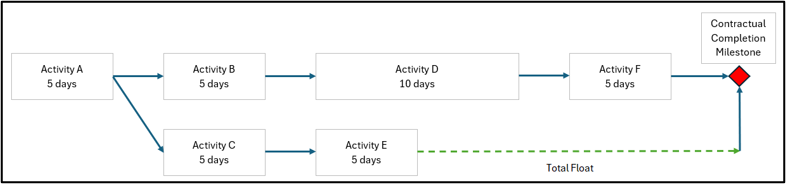
Total Float is the time available between the last activity on the longest path in a schedule network and a specified project completion date. If the contract does not define float ownership, the general assumption is that either party, owner or contractor, may consume float without liability, provided their actions do not negatively impact the specified completion date.
Fig. 2
Terminal Float (NEC Contracts)
Under NEC contracts, terminal float becomes relevant when the client/owner project completion date is later than the contractors planned finish date. The difference between these two dates is known as terminal float.
Fig. 3

Clause 63.3 of the NEC 3 ECC states that any delay caused by a compensation event is assessed by how much later planned Completion becomes compared to the Accepted Programme. If the Employer causes a delay, the Contractor is entitled to an extension of time (EOT) to the Planned Completion, even if there is float between Planned Completion and Project Completion.
Float Ownership
Once the types of float are understood, the next step is determining ownership. The contract should always be the starting point, as it governs the project and sets all the mandatory requirements. In my experience, I have never encountered a contractual clause or stipulation reserving Total Float for a specific party, but it is always worth confirming.
If the contract is silent, float is considered a project resource, meaning either party may use it, provided they do not impact mandatory completion dates such as sectional, planned, or overall project completion.
What NEC says about float
NEC Sub-Clause 31.2 states, “The Contractor shows on each programme which he submits for acceptance provisions for float and time risk allowances.”
The NEC guidance notes emphasizes that float and time risk allowances are distinct, and it must be clearly identifiable on the programme.
It further defines float as spare time within the programme after time risk allowances are included. It is generally available to absorb the time effects of compensation events to avoid delay to planned Completion. However, Sub-Clause 63.3 states that float between planned Completion and the project or contractual Completion Date is not available for use. Any delay to planned Completion caused by a compensation event therefore results an equivalent delay to the Completion Date.
Time risk allowances included in the schedule/programme by the Contractor and submitted for acceptance must be realistic. If they are not, the Project Manager may rely on Sub-Clause 31.3 and refuse acceptance of the schedule/programme.
What FIDIC says about float
FIDIC is silent on the subject of schedule float.
Time Risk Allowance
Time risk allowance is not float. It is time reserved exclusively for the Contractor’s use.
Like float, it is often contentious, but it should never be overlooked as failing to include adequate time risk allowance exposes the contractor to undue risk. Competent contractors should quantify and include time risk allowances in the project schedule.
NEC Sub-Clause 31.2 requires Contractor's to show time risk allowances in the schedule/programme as clearly identified allowances or embedded within activity durations. These allowances belong to the Contractor and forms part of his realistic planning to cover risks. They must remain in place when assessing delays to planned Completion caused by compensation events.
In my view, schedule time risk allowance should exist both at the activity level and at overall schedule level. Its primary purpose is to protect the Contractor from exposure to liquidated damages, and therefore it should be positioned between critical path activities and the contractual milestones associated with liquidated damages.
Fig. 4 below shows that there is a requirement to have material on site by a specific date. The contractor has allowed for relevant shipping and custom clearance time based on previous experience, however because there is uncertainty regarding the port material will be unloaded at a further 5-day allowance has been added to the network to account for any possible delays that could occur. This essentially allows for delays that could happen during shipping and custom clearance. In my view this shows that the contractor is experienced and has thought about events that have the potential to delay and has accounted for that in the schedule.
Fig. 4
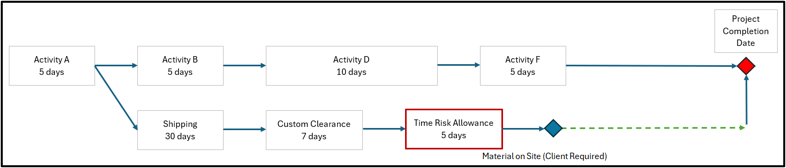
Fig. 5 below shows time risk allowance made for expected weather that could delay the project. This type of time risk is generally provided by the owner, alternatively one could explore the Web for specific weather data in the area of the project. Careful consideration should be given to the type of weather delay is going to be allowed for because it can be either wind, rain, or snow that could impact the project and then there is also the continuing effect that follows the weather event.
Fig. 5

Some non-critical activities may also require specific time risk allowances, typically identified in the project risk register.
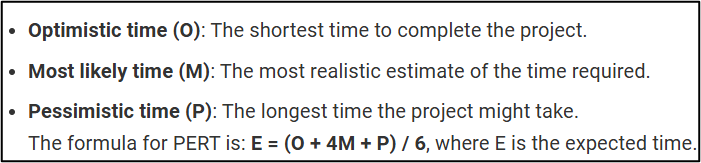
Time risk allowances should not be arbitrary durations. It must be calculated or quantified durations. It is commonly derived from Monte Carlo simulations, which performs a PERT (three-point estimate analysis and produces a quantified allowance for inclusion in the schedule/programme.
Figure 4 – PERT three-point estimation
What FIDIC says about time risk allowance
FIDIC is also silent about time risk allowance.
Conclusion:
- Always understand what your contract states regarding float and time risk allowances.
- It is better to include time risk allowances in the schedule and have them challenged than to omit them entirely.
- Document the time risk allowances in the basis-of-schedule document to ensure transparency.
